


Understanding the Push for a National Environmental Baseline


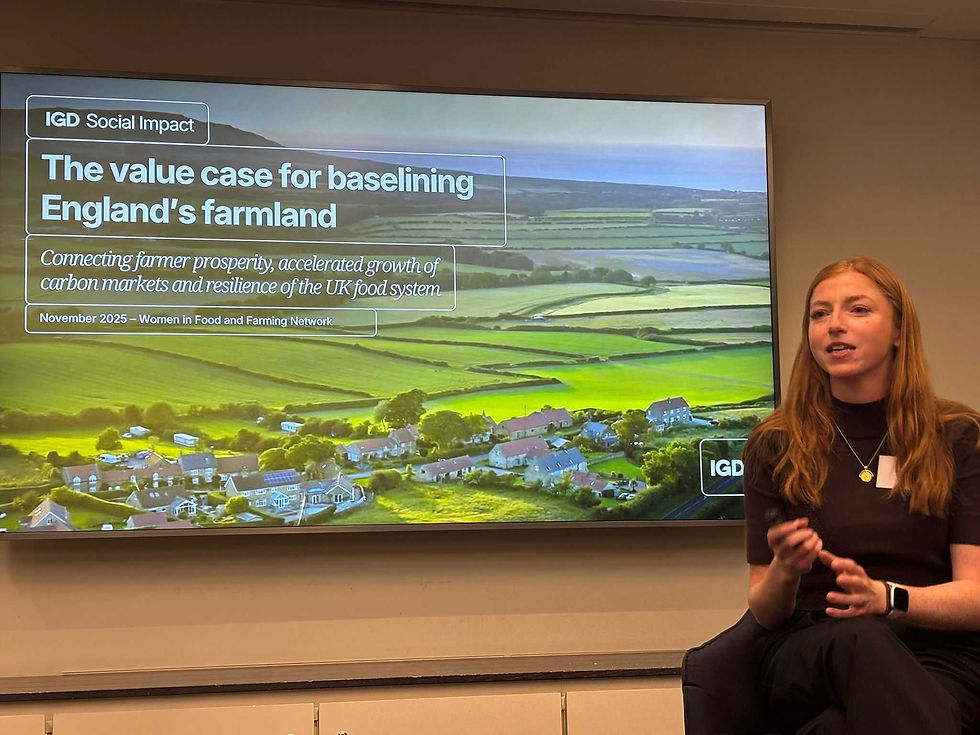
If there was a theme running through our recent event on data and sustainability, it was the growing urgency for a clearer, more coherent understanding of environmental performance across UK farmland. The term “environmental baselining” is not the sort of phrase that sparks instant excitement, yet by the end of the evening it had become a central and compelling topic, thanks to Sarah Haynes from IGD.
Sarah’s presentation explored IGD’s emerging vision for a national environmental baseline. She was joined afterwards by Emily Pope of LEAF and Philippa Wiltshire of Red Tractor for a panel discussion chaired by Clare Otridge, Director of Grounded Research. Clare’s organisation carried out the farmer research underpinning IGD’s new report, ensuring that the voices of the people who would ultimately need to participate were firmly represented.
What followed was a thoughtful examination of how environmental data is collected, what it means in practice, and why a national approach could be both transformative and overdue.
A Wider System, Not a Patchwork of Projects
Sarah began by explaining how IGD has been shifting its sustainability work from standalone initiatives to a broader system-level perspective. Recent reports on resilience in poultry and horticulture, as well as an in depth assessment of how the food system can reach net zero, reflect this wider lens.
Another part of that shift has been IGD’s work with manufacturers on a shared Food Supply Chain Sustainability Framework. This is designed to bring some order to the numerous and often inconsistent environmental requests that reach farms. Anyone familiar with the volume of reporting requirements across the sector will recognise the value of greater consistency.
This framework has paved the way for IGD’s next ambition, which is to explore the case for a national environmental baseline across all UK farmland.
What a Baseline Would Actually Achieve
Sarah set out the heart of the argument. Without a shared understanding of the environmental state of farmland, it is almost impossible for government, supply chains or farmers themselves to plan effectively. Soil health, carbon emissions, carbon stocks and biodiversity are all measured in different ways, using different definitions and with varying levels of accuracy.
The current system gathers a great deal of data, but not in a way that builds a clear or coherent national picture. Sarah described it as a patchwork stitched together from different motives and methodologies.
A national baseline would not only improve clarity. It would also help the sector target investment, reduce duplication, and support the wider transition to net zero and greater resilience.
The Benefits Across the Food System
Sarah explained that the value of a national baseline extends far beyond environmental reporting.
For farmers, accurate and farm specific information supports better decisions, from soil management to investment planning. If incentives were linked to meaningful outcomes rather than simply filling out forms, baselining could help unlock new sources of income. Many farmers are already operating on tight or negative margins, so improvements that strengthen business resilience are significant.
For retailers and manufacturers, a shared baseline could transform the way Scope 3 emissions reporting is approached. Instead of building separate and often duplicative data systems, businesses would be able to work from a common foundation, ensuring that investments and interventions are directed where they will have the greatest impact.
For government, a national baseline would support climate reporting obligations and long term national resilience planning. It could also open the door to participation in future global carbon and nature markets.
Sarah summarised it clearly: individual data sets are useful, but together they could offer insight on a scale that shapes the direction of the entire food system.
What Farmers Told Us
Clare Otridge used the findings from Grounded Research to bring farmer attitudes into the discussion. These were not what many expected.
Farmers are not, in principle, resistant to environmental baselining. Many already collect considerable amounts of data. What matters to them is how that data is handled. They want clarity, control and fair use. They want systems that recognise the time and cost involved. And they want evidence of genuine benefit, either financial or practical.
There are significant differences across sectors. Dairy farmers, who often work within long established data sharing arrangements, tended to be more receptive. Parts of horticulture, where administrative burden is already high, were more cautious about additional requirements.
The strongest message was that any national baseline must be designed with farmers, not imposed upon them.

The Barriers That Still Exist
When Emily Pope and Philippa Wiltshire joined Sarah for the panel discussion, the complexity of the challenge became even clearer.
Agriculture carries significant risk, and farmers shoulder most of it. New practices can take years to generate benefits. Meanwhile, private sector schemes, each with their own metrics and tools, are proliferating. The result is duplication, confusion and frustration.
Philippa spoke about the need to reduce repetition. Farmers may be asked for the same information several times by different organisations. Emily highlighted the limitations of current technologies, particularly those relating to carbon removals and soil carbon stocks, which are not yet reliable or affordable enough to support widespread use.
Despite the volume of data already in circulation, the sector lacks the coherence needed to use it effectively.
Towards a Collective Plan
There was, however, a sense of optimism. Sarah outlined IGD’s intention to develop a shared national strategy, built on consistent governance, commonly agreed metrics and a clear vision of what a baseline should achieve.
A critical next step will be the economic analysis needed to demonstrate the costs and benefits in a way that government can act upon. This work is planned for 2026 and will be an essential part of building momentum.
Emily emphasised the cultural shift required. Data should not be framed as a bureaucratic burden, but as a tool that supports efficiency and strengthens resilience. Philippa stressed that any national approach must be accessible and easy to use, especially for farmers who do not have technical support teams. Clare added that the research is clear: farmers are willing to engage, but only if the system respects their time, knowledge and autonomy.
Looking Forward
The concluding message was that the next few years will be decisive. Environmental data is fast becoming a central part of supply chain relationships, investment decisions and policy design. A national environmental baseline will not answer every challenge, but without one the food system will struggle to manage the pressures ahead.
The evening closed with a shared sense that progress is possible if the sector takes a collective and pragmatic approach. Thanks to the work of IGD, LEAF, Red Tractor and Grounded Research, the conversation about environmental data is expanding, and it is becoming grounded not just in policy or theory, but in the realities of farm businesses across the country.
The discussion has now begun in earnest, and it has begun in the right place: with the people whose land, decisions and expertise will shape the outcome.


Comments